Last Updated on 7 April 2026 by Alf
## Chapter 1
I landed on planet earth to the screams of my poor mother on Wednesday June 6th 1962 at 15:00, or 3pm in old money. “Never again”, she was heard to say afterwards, and like with most things she said, she meant it.
I imagine that my father was in the betting shop at the time, as back in those days the Epsom Derby was run on a Wednesday, and it was a big event. Larkspur won the race under Neville Sellwood and trained by the Irish legend Vincent O’Brien, his first winner of six in the race down the years. I’m told that the midwives at Mowbray Maternity Hospital in Exeter were cursing me, as they had to miss this annual televisual feast to pull me kicking and screaming into the burgeoning swinging sixties. I was a sickly child, to be honest.
The flat my parents rented in St Leonards, a more upmarket district of the city, was in an old Victorian house. It was damp and cold with coal and paraffin heating, and was a fertile breeding ground for the asthma which soon made an appearance. We lived there because my father was brought up on a notoriously rough council estate in the city, and along with two of his siblings was determined to get out as soon as possible. After attending the local grammar school he joined the RAF and never went back.
On leaving the service he married my mother and took private rented lodgings. And given that some forty odd years later, and after living on that very same council estate for ten years, I don’t blame him. He left this world aged 49 after a long struggle with pain, and the alcohol he used to numb it. The pain was caused by a hernia which was twisted around his bowel and which, at that time was inoperable. The hernia being the result of helping a colleague lift a piano in the council building after work. As it was after work of course there was no compensation or sympathy as far as I could tell.
His doctor, prospective MP Adrian Rogers had no sympathy for drinkers, and was also notoriously anti-gay, describing homosexuality as a “sterile, disease-ridden, God-forsaken occupation”. Rogers lost his only attempt at being an MP in 1997 after being thoroughly thrashed by the openly gay Labour Party candidate, Ben Bradshaw who remained the Member of Parliament for Exeter until 2024. Rogers was subsequently kicked out of the Tory party, which needs no further comment.
My mother, in contrast was brought up in a small cottage in one of the city’s parks opposite the local bowling green. She was the youngest of five children and the only girl. During the war she was terrified by a low flying German pilot as the hun wreaked havoc during the Exeter Blitz of April and May 1942 as part of the so-called “Baedeker raids”, in which targets were chosen for their cultural and historical, rather than their strategic or military, value. She died of cancer aged 72 in 2005.
Her father was the groundsman of the park and bowling became synonymous with the family name from there onwards. He died when I was too young to remember. Her mother was a housewife (remember them?) and became part of the duo with my mother who brought me up until she eventually passed on in our house in the early ’80’s.
—-
Birth, school, work, death. Yep, that’s about the sum of things. Like most folks I had to kick my heels until I was 5 years old before I was sent to my local Primary Indoctrination State School where I would remain until I was around 9 years old.
_The stench! The bloody stench! It will stay with me until long after I’ve shuffled off this mortal coil._
Boiled cabbage bubbling in the school kitchen – day after day – week after week – month after month. There are two things I remember from my first days at Newtown school (a short walk from where we lived). The smell of that evil concoction, and a Chinchilla in a cage.
Chinchillas make ideal pets and classroom ornaments. Not only can they jump up to six feet high, but they eat their own excrement, negating the need to clean up after them. The only drawback of this of course is that they never produce white faeces; what a bummer I hear you cry.
Sadly the gymnastic prowess of this cute rodent were never seen, as Chinchillas are not too social during daylight hours, but I’ll bet this little rogue had a ball each day when the cabbage was extinguished and the doors locked until the next school day. I’d say that there was a fair chance that he was joined by some “party rats” after lights out. And why not?
This leads me into my first memory of learning, as my primary school teacher, Mrs Hayter banged it into us that we should NEVER start a sentence with the word “And”. And until now I never have. Sorry miss, but times change.
Like all schools of the time we had the mandatory “assembly”, which gave all of the less balanced pupils an excuse to faint. This occurred on a daily basis which was great because it put back the start of lessons whilst that sickly child was attended to. I never fainted; probably because there was always one who beat me to it. This would become an ongoing issue in the years to follow. At the 11am “playtime” we were given a half pint bottle of milk to drink through a straw, although there was always someone who was allowed to drink orange juice.
I’d imagine that if this were the norm today half the class and more would be fainting through the sheer shock of having to drink milk from a cow. You might have guessed by now that I am pretty intolerant of the intolerant.
Playtime was always a good time to have a go on “the ladder”, which consisted quite literally of a wooden ladder suspended around 6 feet from the ground and which allowed pupils to swing like monkeys from rung to rung. The true sporty types could manage to get across it in around 4 swings using every fourth rung. The rest of us could only manage 3 rungs max, but there was much competition and a few nasty landings on to the tarmac below. The master of the ladder was a tall thin lad called Timothy, who was soon to become my nemesis in the annual school swimming gala.
As far as diversity went, the school was mostly white, with the main exception of some Sikh Indians who lived adjacent to the school. They were good lads who’s parents were in the retail business, and as this was a time of life before the peers or parents could twist young minds with colour prejudices, all was well in the hood – for now.
I soon made it clear to my parents that I was not able to digest the school dinners. The boiled green spew, coupled with potatoes that were seemingly mashed by an imbecile were inedible. I’ll never forget the dark green lumps which would not melt even on the rare occasions that gravy was involved in the creation of said meal. It was like eating in a Dickensian workhouse but where nobody was crazy enough to ask for more. My complaints had little impact on the parents for a long time, but I was eventually allowed to walk home for dinner, as did my father from his job as an administrator at the City Council office where he worked for most of his life.
Dinner was cooked by my maternal grandmother (nan), who travelled the 2 miles or so from her council flat on the bus each day. My mum worked half a mile away in the County Hall, rising from the typing pool to eventually become secretary to the County Solicitor. She cycled to work and back each day, including for her dinner break.
Ideal one might think, a proper family scenario, but this was not the case. As I later discovered the old man did not get on with the mother-in-law for reasons which were never made clear to me. I’ve always been a bit slow to get the gist of family matters. As a result he was served his food in the front (living) room whist we ate in the small kitchen along the passageway, and woe betide anyone who interrupted his 1pm feast. Frequently one of my four maternal uncles would appear at around this time with requests for a loan from nan until payday. Occasionally, Uncle Dave would call around and would give me a lift back to school on his motorcycle, with instructions to hold on tight as he powered away up the street. Quite frankly the 2 or 3 minutes it took to reach the school terrified me.
My maternal relatives were a steadfast bunch, not given to drinking, smoking, leaving Exeter or anything which I personally would deem a necessity in life. To a man they were enthusiastic bowlers and this included my mother to a lesser extent. They were/are good people who for the most part we only saw at Christmas and other such family occasions. This was no doubt in part as a result of my father’s resistance toward family stuff; a trait which I inherited myself. Some people might call it rudeness, but I don’t see it that way given the way I’ve seen families treat one another. It’s lucky you can choose your friends.
The paternal side was a different, and far more interesting matter. My grandfather originated from what was known as the “West Quarter” of Exeter, which was basically a slum until the 1930’s. The West Quarter was an impoverished slum area, during the 19th century, with crowded and unhygienic accommodation. By the 1920’s soup kitchens had been set up to feed the poorest. The City Council decided that something must be done about the conditions, so the council embarked on an ambitious development of new housing, using some of the new ideas developed by the Garden City movement. In February 1928 a compulsory purchase order was made by the City Council for 90 acres of farmland on either side of a lane in Wonford which took its name, Burnthouse Lane, after a farmhouse that burnt to the ground one Saturday Night. It used to get lively down that way back in the day.
Ironically the West Quarter is now the trendiest part of town, probably made possible in part by the thousands for ultra-rich students from Exeter University who shop, and more increasingly live there. But I digress……
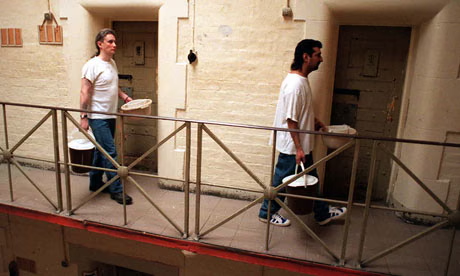
So it was that Charles Percival Alford (Char) moved into a brand new council house to bring up his new young family. This was situated at 47, Shakespeare Road, in the heart of the community and just a stone’s throw from the new church, St Pauls where Char used to show his rabbits and win medals. The back garden at Shakespeare Road was basically taken up with around three rows of rabbit hutches and a small vegetable garden at the top. As a side note, his auld fella, also of course called Charlie got into a fight in the cathedral green in the late 1800’s and spent time in Exeter prison. In the late 1900’s I was done for exactly the same crime, and spent my own time at this fine establishment. I’ve never liked Christmas……….and Charlie the tailor, who also dwelt in the West Quarter, down by the quay probably felt the same.
My father had two sisters and a brother. Phyliss was to stay in Burnthouse Lane her entire life and was known for her lively manner, straight speaking and ability to drink others under the table (mmmm, I see what she did there). Her husband, my uncle Bill was allegedly the fastest bricklayer in Exeter, and looked a lot like Frank Sinatra – well, he thought so anyway. Their kids, Billy and Mandy are/were typical council estate fodder, sharp witted and good company by all accounts.
Then there was Margaret, known of course as Peggy who wised up during the war, married a US soldier and spent the rest of her life chewing gum (chum) and living it up in California with my erstwhile cousins. The eldest brother, Ivan moved to New Zealand like many other Brits in the 1950’s and became a sheep farmer. He was also known to down a few jugs from time to time and allegedly dies of an alcohol related disease; what a surprise.
Meanwhile, back in the classroom I worked toward the 11+ exam, which was the ticket to study at the local grammar school, Heles. Whether you agree with the Tripartite System with its academic, technical and functional strands, which was introduced to try and match schooling to the ability of the child in those three disciplines is a matter of personal opinion. It turned out not to make damned difference as they abolished it the year before I was due to sit it, and for me this would prove to be a major turning point.
And so it was that in 1972 I took my place at the newly created “middle school”, rather than the loftier grammar school, before ascending the giddy heights of “secondary modern” education, followed by the ultimate Alma Mater, HMP Haslar Detention Centre aged 17.